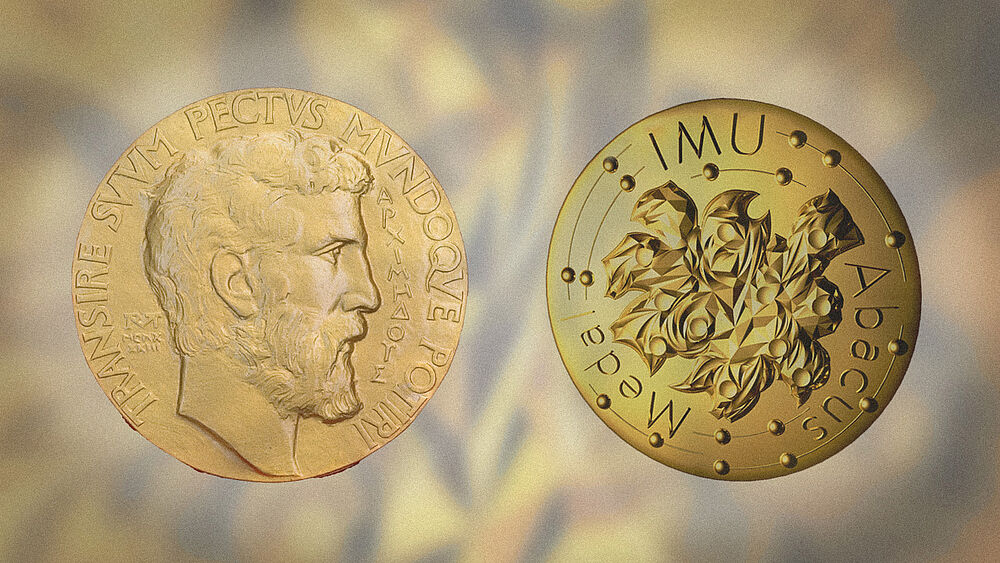
Congratulations to recipients of the 2026 Fields Medal and the IMU Abacus Medal!
We would like to congratulate the recipients of the 2026 Fields Medal and IMU Abacus Medal!
Yu Deng was awarded the Fields Medal “for his work in partial differential equations, including the rigorous derivation of the Boltzmann equation from hard-sphere dynamics for rarefied gases, the derivation of wave kinetic equations from nonlinear dispersive systems, and probabilistic approaches to nonlinear Schrodinger dynamics.”
John Pardon was awarded the Fields Medal "for his achievements in symplectic geometry including new approaches to virtual fundamental cycles, Fukaya categories of certain manifolds and counting holomorphic curves, and for his contributions to other areas of geometry and topology, including group actions on 3-manifolds and knot theory.”
Jacob Tsimerman was awarded the Fields Medal “for his contribution in the recasting of o-minimality as a fundamental method of arithmetic and complex algebraic geometry, and his role in the proof of many central conjectures including Griffiths' conjecture on the algebraicity of images of the period maps, and the Andre-Oort conjecture for Siegel modular varieties.”
Hong Wang was awarded the Fields Medal “for her work in harmonic analysis and geometric measure theory, including applications of multiscale and decoupling techniques to the local smoothing conjecture for the planar wave equation, and major advances in Fourier restriction, Falconer distance sets, Furstenberg sets in the plane, and the Kakeya problem in three dimensions.”
Finally, Shayan Oveis Gharan was awarded the IMU Abacus Medal “for his landmark contributions to the theory of algorithms, taking the analysis of algorithms beyond combinatorics and probabilistic analysis into the theory of the geometry of polynomials and related topics. This theory has led to deeper understanding of distributions on spanning trees and matroid bases in general. Oveis Gharan’s work improved the approximation of the metric travelling salesperson problem, breaking the limit on the approximation factor in Christofides’ 3/2-algorithm from 50 years ago, and led to a revolution in the understanding of Markov Chain Monte Carlo sampling algorithms (proving the Mihail-Vazirani conjecture and giving a self-contained proof that resolved the strongest version of Mason's conjecture) through spectral independence.”