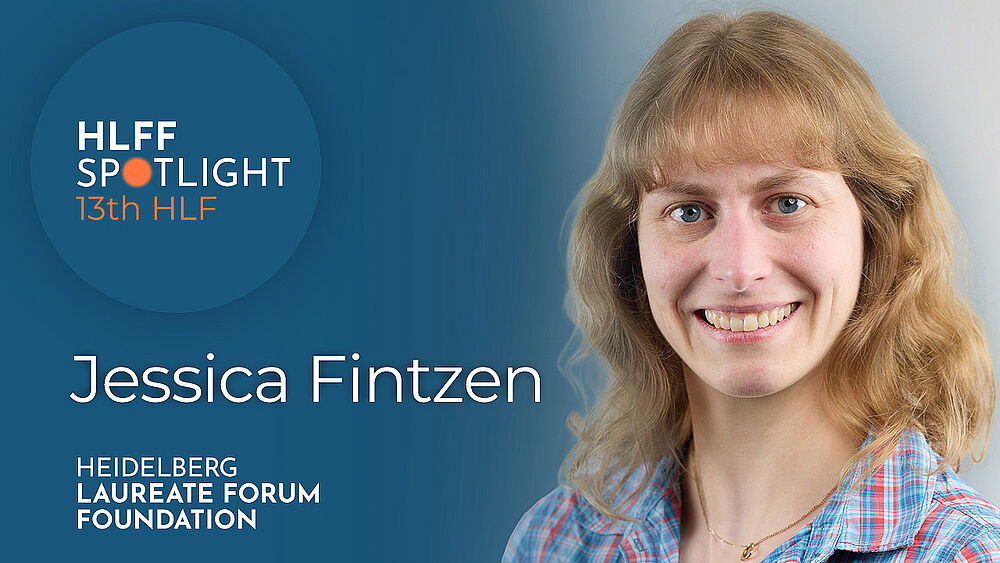
Jessica Fintzen
The Heidelberg Laureate Forum has a single purpose: To provide some of the brightest minds in mathematics and computer science with the space and time to make connections and find inspiration. The HLFF Spotlight series shines a light on some of the brilliant individuals attending the event.
Jessica Fintzen is the Scientific Co-Chair (Mathematics) of the Heidelberg Laureate Forum's Scientific Committee. Fintzen is Professor of Mathematics at the University of Bonn. She has been the recipient of the European Mathematical Society Prize, an ERC Starting Grant, won the AMS Cole Prize in Algebra and received a Royal Society University Research Fellowship. She has also been on the HLF Scientific Committee since 2023.
What first drew you to mathematics, and to representation theory specifically?
It happened gradually, I’ve always liked puzzles and was excited when at some point in school I saw a question about the Seven Bridges of Königsberg. In grade 7, I heard about the concept of the Math Olympiad. There was no training and not much of an organization where I lived, so I just went to one of these competitions, sat the exam, and did not too badly in it; from that point on, I was hooked by these Olympiad problems and tried to solve more old ones on my own. Later, I studied math and physics at the university, and math kept fascinating me until this day.
That I ended up in representation theory is more a coincidence. I did my PhD in the US, where you get admitted to a PhD program and then try to find an advisor among the professors during your first few years of the program. So, at some point I needed to find an advisor. I knew I wanted to do algebra rather than analysis, but beyond that I just looked around for who was available, who didn’t have too many students yet, and who seemed like a good advisor. I asked Dick Gross if he could be my advisor and he suggested I might learn about the structure theory of p-adic groups, which eventually led me into the area of representation theory. Long story short, things just happened.
You've organized quite a few conferences, among them also at least one around community-building in the Langlands Program – what have you learned about what makes a research event actually rewarding for the people in the room?
I think facilitating interactions (in addition to good talks) and ensuring a welcoming environment for all participants are key components that make a research event successful. In the recent conferences that I organized, I included speed-networking events or 50-second introductions of all participants that allowed everyone to get an overview of who is there and who they might like to talk to beyond the speakers. During the last eight conferences I organized, I have also always included contributed talks to give early career mathematicians, whose work I might not yet be aware of, a chance to present their work.
What are you most looking forward to about experiencing the HLF from the Chair's perspective?
Even in previous years, I always attended the HLF as a member of the Scientific Committee, so I always asked myself what can be improved about it and then reported back on it to the Scientific Chair and HLF team. So, I guess this year won’t be too different, except that I have many more responsibilities throughout the week. I am looking forward to hearing feedback from everyone else about what they think worked well and what they like to see improved.
What part of the program of the upcoming 13th HLF are you most excited for and why?
I don’t think there is one particular event in the program that I like to single out, as I am super excited about every single item on the program, all for different reasons. I am also particularly excited about all the interactions that are going to take place; I very much look forward to meeting all the participants.
What's one piece of advice you would give young researchers?
Believe in yourself and don’t get discouraged by rejections. We often only see the successes of others, but we rarely see all the struggles they had to overcome, the applications or fellowship proposals or paper submissions that got rejected, as well as their personal circumstances. The young researchers might learn from the laureates that even the most celebrated minds in our areas had to deal with rejections and had to overcome struggles and backlashes to reach the point they are at now.